


In both professional combat sports and algorithmic gaming, the psychology of risk mitigation dictates performance. In the arena, a fighter must constantly weigh the compounding damage of staying in the pocket against the safety of disengaging. On digital platforms, crash-style games replicate this exact psychological tension.
Roobet’s proprietary title, Mission Uncrossable, isolates this variable. It strips away the complex aesthetics of traditional slot machines, presenting players with a raw, multi-layered decision framework where survival probability decreases with every progressive step.
What is Mission Uncrossable?
Mission Uncrossable is an interactive, crash-style instant game where players guide a character across a multi-lane highway. Every lane successfully crossed applies an incremental multiplier to the original stake. Conversely, a collision with a vehicle terminates the round instantly, resulting in a total loss of the active wager.
Unlike passive slot mechanics governed entirely by continuous automated spins, this structure introduces active manual agency. The participant must mathematically assess whether to cash out accumulated returns or accept compounding risk in pursuit of higher payout tiers.
Is It Legit?
When assessing software-based gaming architecture, safety and structural integrity are paramount. To determine if is Mission Uncrossable legit, one must look at the underlying cryptographic framework rather than surface-level aesthetics.
The platform operates on a Provably Fair cryptographic verification system. This infrastructure guarantees that every individual round outcome is generated deterministically before the wager is placed, preventing real-time manipulation.
- Server Seed: Provided by the platform and hashed beforehand to ensure pre-determination.
- Client Seed: An independent string generated by the player’s browser, introducing unalterable randomness from the user side.
- Cryptographic Verification: Every round hash can be cross-verified retroactively using public SHA-256 tools, proving the platform does not alter operational variables mid-game.
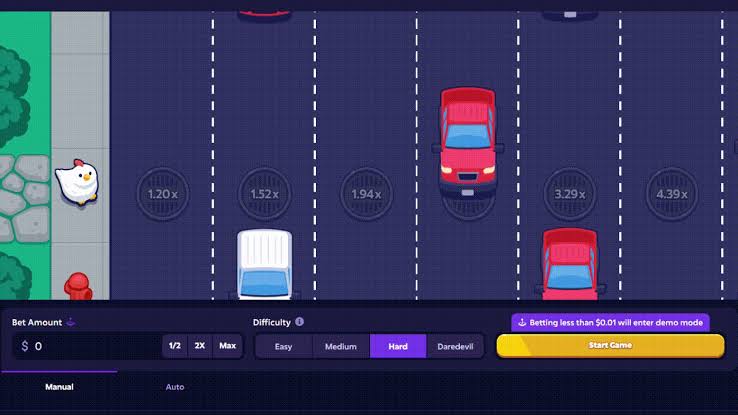 Mission Uncrossable Interface and Lane Multipliers. Source: missionuncrossabledemo.com
Volatility and Difficulty Levels Explained
The mathematical core of Mission Uncrossable relies on a customizable volatility index. Players select from four discrete difficulty tiers, which directly calibrate the collision probability per lane alongside the corresponding acceleration curve of the multiplier.
| Difficulty Tier | Collision Probability per Lane | Multiplier Escalation Curve | Strategic Profile |
| Easy | Low | Linear / Incremental | High Win-Rate / Low Yield |
| Medium | Moderate | Moderate Geometric | Balanced Risk Profile |
| Hard | High | Aggressive Exponential | Elevated Volatility |
| Daredevil | Extreme | Maximum Mathematical Cap | High Risk / Maximum Payout |
Wagers scale from entry-level micro-stakes up to a maximum threshold of $100 per round. Algorithmic limits cap the ultimate potential payout at $1,000,000, creating an asymmetric risk window on higher difficulty settings.
To help map out these risk curves and visualize how difficulty impacts your potential returns, use the simulator below to calculate expected payouts before risking live capital.

How to Access Free Play and Demos
Navigating high-volatility systems requires operational familiarity before deploying capital. Users can access a built-in Mission Uncrossable free play environment on the platform.
This simulation mode functions via a built-in automated threshold. If a user sets their active bet amount to less than $0.01, the system automatically transitions into demo mode. This allows comprehensive stress-testing of betting strategies, difficulty scaling, and manual cash-out response times under identical real-world algorithmic parameters without financial exposure.
Takeaways for Casual Players
Surviving inside the cage or within an algorithmic betting loop requires strict risk boundaries. For casual players looking to optimize their approach to Mission Uncrossable, consider these operational principles:
- The Disengagement Rule: Establish a fixed multiplier target before the round begins. Emotional or reactive decision-making in real-time is mathematically shown to favor the house edge.
- Implement Strict Bankroll Unitization: Wagers per round should never exceed a small fraction (e.g., 1% to 2%) of total allocated capital to withstand consecutive loss streaks.
- Utilize Low-Volatility Buffers: Balancing occasional high-risk Daredevil attempts with systematic, low-multiplier runs on Easy difficulty helps stabilize the variance of your balance over extended sessions.