

There comes a point in any industry when the gap between what consumers expect and what established players deliver becomes wide enough to create real opportunity. Online gambling has reached that point. The brands that built the industry — large, well-funded, deeply entrenched — continue to operate strong products. But the players using those products, and the larger number of players evaluating their options for the first time, are looking at the market with fresh eyes and finding that the landscape has changed around the incumbents. FanDuel exemplifies this dynamic. It remains an industry giant by every measurable standard. Yet the persistent and growing volume of searches for FanDuel alternatives confirms that a substantial audience wants something the current leaders were never built to provide. That audience is finding ZunaBet — a crypto-native casino and sportsbook that launched in 2026 and delivered a platform that does not iterate on the existing model but replaces it entirely.
FanDuel: What Made It Great and What Holds It Back
FanDuel’s rise is one of the defining stories in online gambling. The company identified the potential of daily fantasy sports before most competitors understood the category, built a user base numbering in the millions, and converted that foundation into a sports betting and online casino powerhouse as American regulations opened new markets. Today it holds active licenses in a large number of US states, operates one of the most downloaded gambling applications in the country, and maintains partnerships with major sports leagues and media organizations that guarantee constant visibility.
The sportsbook remains one of its strongest assets. NFL, NBA, MLB, NHL, college athletics, international football, tennis, golf, combat sports, and other disciplines all receive solid coverage. The casino section provides a thoughtfully assembled selection of slots, table games, and live dealer experiences. The mobile app is well engineered, regularly updated, and built for smooth performance. FanDuel knows how to operate a gambling platform at scale, and that expertise shows throughout the product.
Financial transactions run through the standard infrastructure — bank accounts, debit and credit cards, PayPal, Venmo, and similar conventional payment methods. These channels provide the accessibility that a mainstream-focused platform requires to minimize barriers during onboarding and daily use.
What holds FanDuel back is not incompetence. It is architecture. The platform was built during a period when moderate game libraries were sufficient, when traditional payment processing was the only realistic option, and when loyalty programs needed to exist but did not need to impress. Those conditions defined the design choices that shaped FanDuel into what it is. The conditions have since changed dramatically. Players now expect vast content catalogs, instant low-cost transactions, and engagement systems that feel personally rewarding. FanDuel’s product was not designed to deliver on those expectations because those expectations did not exist in their current form when the product was designed. The search trend is the market’s way of saying the gap has grown too wide to ignore.
ZunaBet: Built for Expectations That Already Exist
ZunaBet entered the market in 2026 with none of the legacy constraints that limit older platforms and all of the insight into what modern players actually want. Owned by Strathvale Group Ltd and run by a team with over 20 years of combined gambling industry experience, it operates under an Anjouan gaming license with registration in Belize. The platform was not adapted from a traditional model. It was built from a blank page with cryptocurrency as the foundational infrastructure and the modern player as the sole design target.
The game library tells that story immediately. ZunaBet launched with 11,294 games from 63 providers — a number that would be impressive for a platform operating for a decade, let alone one opening its doors for the first time. The provider roster anchors itself around the biggest names in the industry — Pragmatic Play, Evolution, Hacksaw Gaming, Yggdrasil, BGaming — and extends through dozens of additional studios that collectively ensure depth across every game category. Slots constitute the largest portion of the catalog, consistent with every casino in the market, but ZunaBet’s RNG table game selection covering blackjack, roulette, baccarat, and multiple poker variants stands on its own as a substantial offering. The live dealer section delivers premium real-time streaming from top studios, providing the kind of immersive experience that was once the exclusive domain of physical casino floors.
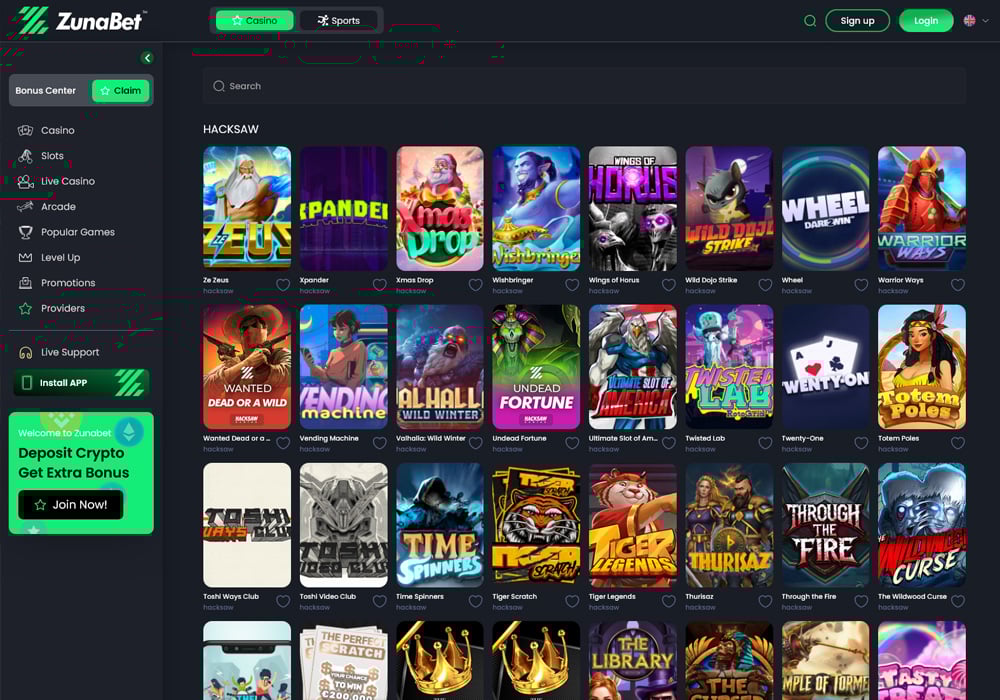
What 63 providers contributing 11,000-plus games creates is an ecosystem of content so varied that players experience genuine diversity every time they browse the catalog. Different studios bring different philosophies to game design — different mechanics, different visual identities, different approaches to payout structures and bonus features. The result is a platform where no two sessions need to feel alike and where the experience of finding something new remains alive for months of regular use. Content exhaustion, one of the primary drivers of player churn across the industry, is effectively neutralized by the sheer scale and variety of what is available.
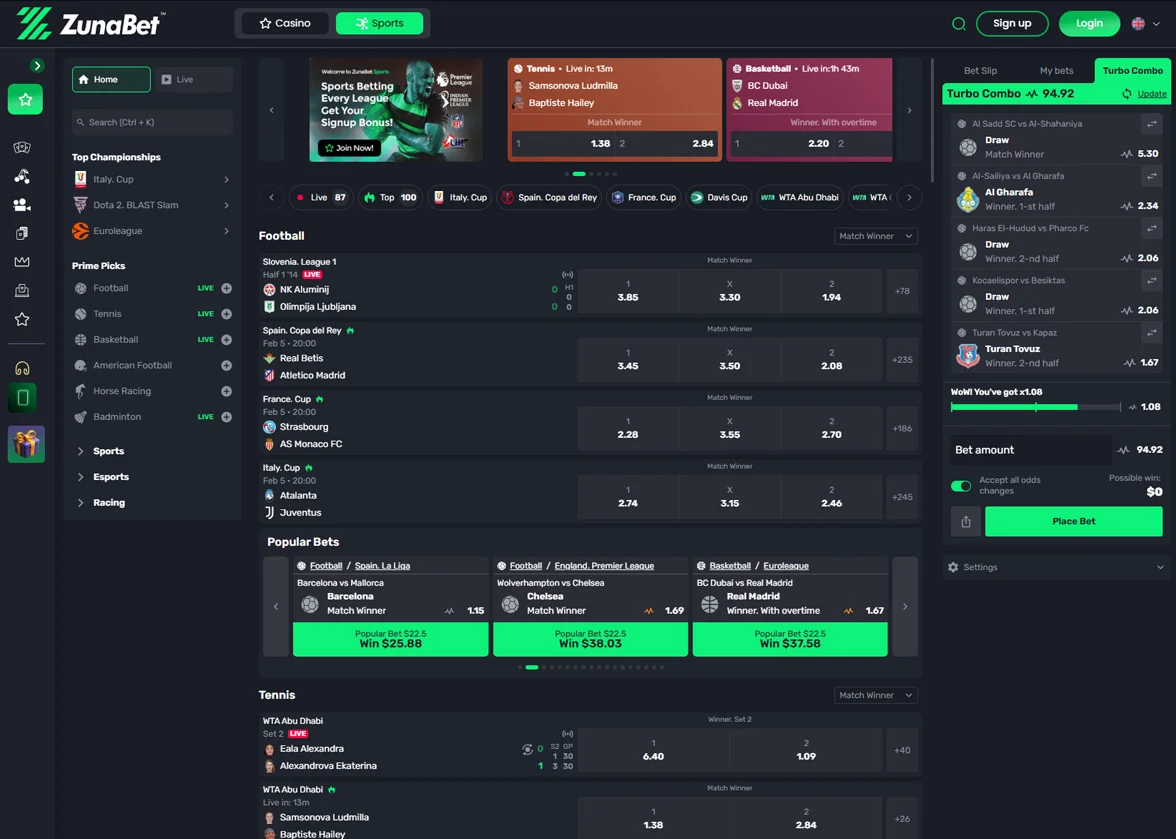
The sportsbook provides the same depth on the betting side. Football, basketball, tennis, NHL, combat sports, and virtual sports are covered comprehensively. Esports receives full treatment with active betting markets on CS2, Dota 2, League of Legends, and Valorant. This is a reflection of who the crypto-native gambling audience actually is — a demographic that watches esports alongside or instead of traditional athletics and expects its betting platform to respect both equally. ZunaBet built for that reality, giving it immediate relevance with an audience that traditional operators have repeatedly failed to engage.
The payment system accepts more than 20 cryptocurrencies — Bitcoin, Ethereum, USDT on multiple chains, Solana, Dogecoin, Cardano, XRP, and additional tokens. No platform processing fees are charged. Withdrawals move through blockchain networks that run continuously, settling in minutes at any hour of any day. Because the payment infrastructure was designed around crypto from the outset, the experience carries none of the friction or inconsistency that emerges when crypto is layered onto traditional fiat systems. Everything flows through a single clean path that is fast, free, and identical for every transaction.

New players access a welcome package totaling up to $5,000 plus 75 free spins over three deposits. The first deposit qualifies for a 100% match up to $2,000 with 25 free spins. The second receives a 50% match up to $1,500 with 25 spins. The third closes the package with a 100% match up to $1,500 and 25 spins. Spreading the bonus across three deposits is a retention-focused structure that gives players recurring reasons to return and engage with the platform over multiple sessions.
The technical foundation uses HTML5 to deliver a dark-themed responsive interface with fast loading performance across all device types. Native apps are available for iOS, Android, Windows, and MacOS. Live chat support operates without interruption at every hour of every day.
Crypto Payments Are Not a Feature — They Are a Different Foundation
Framing cryptocurrency support as a feature misrepresents what it actually is when implemented the way ZunaBet has implemented it. A feature is something added to an existing product. What ZunaBet built is a payment infrastructure that operates on fundamentally different principles than what traditional platforms use, and those principles produce a fundamentally different experience for the player.
On a traditional platform, every financial transaction passes through at least one and often several intermediary institutions. Each intermediary adds processing time and may add cost. Deposits might arrive promptly through certain methods, but withdrawals enter a pipeline that includes platform approval windows, banking processing queues, and method-specific settlement periods. The timeline is measured in business days, which means weekends and holidays create dead zones where nothing moves. A player requesting a withdrawal on Friday evening might not receive funds until the middle of the following week. Transaction fees charged by platforms, banks, or payment processors reduce the amount that ultimately reaches the player’s account.
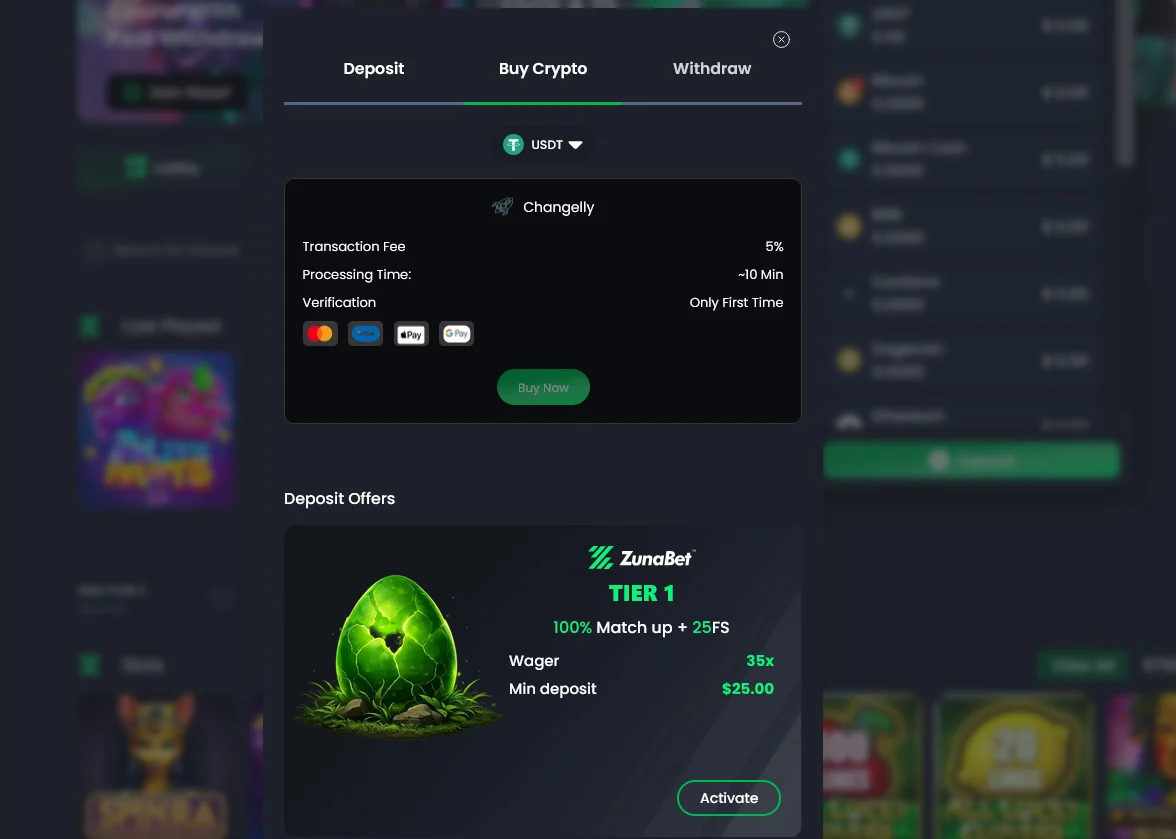
On ZunaBet, a transaction is a single event. The player initiates a deposit or withdrawal. The blockchain confirms it. The funds move. The entire process takes minutes. It works identically at midnight on a public holiday as it does at noon on a Tuesday. ZunaBet charges no processing fees. The minimal network fees inherent to most blockchains are negligible for the cryptocurrencies the platform supports.
The cumulative difference across a year of regular use is not subtle. A player who makes weekly deposits and withdrawals on ZunaBet saves days of aggregate waiting time and meaningful amounts in fees compared to performing identical transaction volumes on a traditional platform. These are not promotional savings. They are permanent structural advantages that apply to every transaction because the infrastructure itself is more efficient.
ZunaBet’s payment experience feels effortless because it is architecturally simple. There are no hybrid systems. There is no fiat layer creating drag. Every transaction travels the same clean, fast, free path because the platform was never designed to accommodate anything else.
From Points Programs to Dragon Evolution
The loyalty landscape in online gambling represents one of the most striking examples of industry-wide complacency. Virtually every operator runs the same program — wagering generates points, points accumulate toward thresholds, crossing thresholds produces rewards. The experience is so uniform and so unremarkable that most players could not describe their current loyalty tier or recall the last reward they claimed. The programs function as passive retention tools that generate zero active engagement.
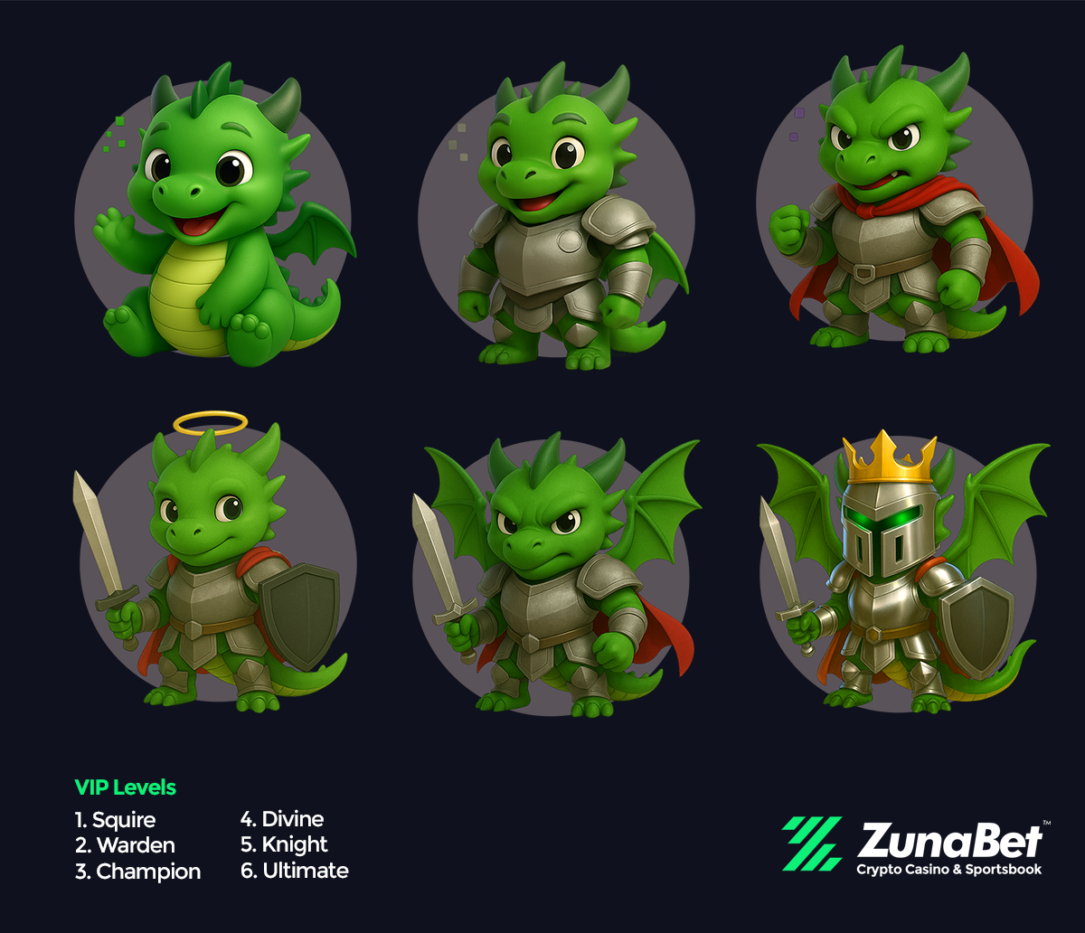
ZunaBet built a loyalty system that demands attention and rewards it. The dragon evolution program progresses through six tiers, each with a distinct name, identity, and escalating reward package. Squire starts at 1% rakeback. Warden advances to 2%. Champion moves to 4%. Divine reaches 5%. Knight jumps to 10%. Ultimate caps the system at 20% rakeback. Beyond the rakeback rates, each tier delivers expanding benefits — free spins that build toward 1,000 at the top tier, VIP club access, and double wheel spins. A dragon character named Zuno provides visual continuity through the entire progression, evolving in appearance with each tier advancement to give the player a tangible representation of their journey.
Every element of the system draws from video game design principles. Defined levels with transparent requirements. Rewards that scale meaningfully at each stage, making progression always worth pursuing. Visual evolution that turns abstract advancement into something players can see and take ownership of. Achievement mechanics that make reaching each new tier feel earned and significant rather than automatic and forgettable.
The impact on player behavior is measurable. ZunaBet players actively track their loyalty progress. They plan around tier milestones. They experience genuine satisfaction when they advance. These are emotional responses that traditional points programs are structurally incapable of producing because their design does not attempt to produce them. ZunaBet’s loyalty system works as both a retention tool and an entertainment feature because it was designed to function as both simultaneously. That dual purpose gives it a power that conventional programs operating purely as administrative mechanisms will never match.
What the Search Data Confirms
The record-breaking volume of FanDuel alternative searches confirms what the rest of the evidence already suggests — the online gambling market is undergoing a generational transition. FanDuel will remain a significant player. Its brand strength, regulatory positioning, massive user base, and financial resources guarantee continued relevance in the markets it was built to serve. That foundation is solid and durable.
But the foundation of the market itself is expanding beyond what FanDuel was constructed to address. The players driving growth want payments that settle instantly without fees. They want game libraries so extensive that months of exploration still leave new territory to discover. They want esports treated as a primary betting category. They want loyalty systems built with creativity, intentionality, and an understanding of what makes engagement genuinely rewarding. They want platforms designed for the digital world they inhabit today, not the one that existed when the last generation of gambling brands was built.
ZunaBet was engineered from scratch to deliver on every single one of those wants. Its game library rivals the largest in the industry. Its payment system moves money faster and cheaper than traditional infrastructure can. Its esports coverage meets a growing audience where it already is. And its loyalty program replaced the most tired convention in online gambling with something players actually enjoy. That total package is why the search trend leads to ZunaBet over and over again. Players are searching for the next era of online gambling, and they keep arriving at the same destination because ZunaBet is the most complete version of that era that anyone has built so far.