

Somewhere right now, a DeFi protocol with better yields than its top competitor has 300 users. An NFT platform with tools that creators genuinely prefer has processed fewer transactions this month than its rival processed yesterday. A Web3 infrastructure project that three major applications depend on has never been mentioned in a single publication its potential customers read.
None of these projects have a product problem. They have an awareness problem. And it is killing them slowly.
The uncomfortable truth about the DeFi, NFT and Web3 sectors is that technical excellence has almost no correlation with market awareness. The projects that dominate mindshare are not necessarily the best. They are the ones that showed up earliest and most consistently in the places where their audiences look for information. Every project that comes after them faces the same uphill battle: proving they exist to an audience that has already made its choices based on what it found first.
Kooc Media, a PR distribution agency serving the crypto, fintech, technology and iGaming industries since 2017, gives DeFi, NFT and Web3 projects a way to break into those information channels. The agency provides guaranteed article placements across its own network of established news websites and distributes content through major business and finance newswire services. Coverage is published within hours, confirmed before the campaign starts and lands on publications that crypto audiences use daily.
“Technical superiority means nothing if nobody knows about it,” said Michelle De Gouveia, spokesperson for Kooc Media. “We work with projects that should be market leaders but are not, purely because they never solved the visibility problem. That is specifically what we fix.”
Why the Best Projects Often Lose
The DeFi, NFT and Web3 markets are supposed to be meritocracies. Open-source code. Transparent on-chain data. Permissionless participation. In theory, the best protocol wins because anyone can verify that it is the best.
In practice, verification requires attention. A user has to know a protocol exists before they can evaluate it. A developer has to encounter a Web3 tool before they can assess whether it fits their stack. An investor has to find a project before they can analyse its fundamentals. Discovery comes before evaluation, and evaluation comes before adoption.
The discovery layer in crypto is broken. There is no equivalent of an app store where DeFi protocols are ranked and reviewed. There is no search engine optimised for finding the best NFT platform for a specific use case. There is no curated directory of Web3 infrastructure that developers trust. Instead, discovery happens through a messy combination of social media, word of mouth, conference appearances and — most importantly — coverage on established crypto, finance and technology news sites.
Media coverage is the closest thing the DeFi, NFT and Web3 sectors have to a discovery engine. An article on a respected publication reaches people who are actively searching for information. It ranks in Google for relevant queries. It gets shared on social media. It gets cited in newsletters and community discussions. It creates a reference point that persists indefinitely.
Projects without media coverage are excluded from this entire discovery mechanism. They exist only within their own community channels — visible to the people who already know about them and invisible to everyone else.
Kooc Media’s crypto PR services break this cycle by guaranteeing DeFi, NFT and Web3 projects the media coverage that the traditional PR industry cannot reliably deliver.

What Guaranteed Actually Means
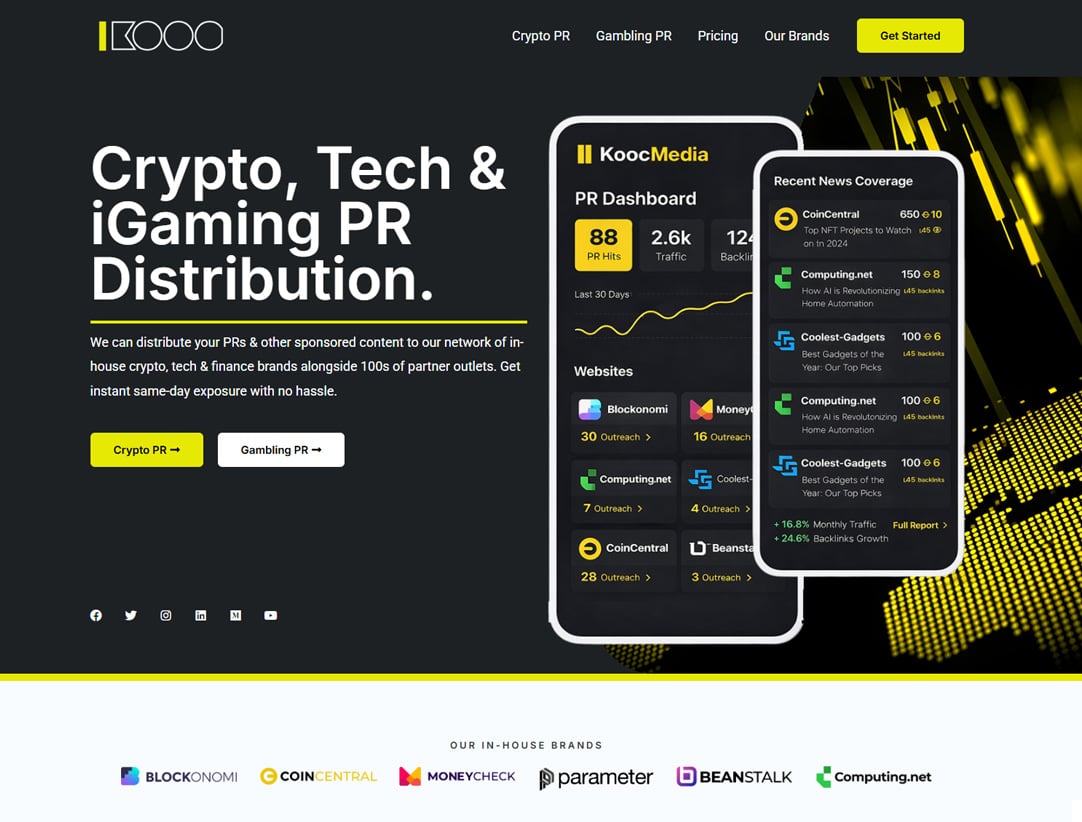
Kooc Media can guarantee placements because it owns the publications. This is not a partnership arrangement or a preferred relationship with friendly editors. The agency owns and operates Blockonomi, CoinCentral, MoneyCheck, Parameter, Beanstalk and Computing outright. These are established publications with years of daily content, genuine readerships, strong domain authority and organic search traffic across crypto, finance and technology topics.
When a DeFi protocol, NFT platform or Web3 project books a campaign, the exact publications are named before commitment. The article is written by Kooc Media’s in-house editorial team — specialist writers who cover decentralised technology daily — and published on the confirmed sites. Typically the same day. The client receives live links to each placement. The coverage is real, permanent and independently verifiable.
There is no pitch to an external journalist who might not open the email. No editorial review by someone who might not understand what an automated market maker does. No three-week silence followed by a polite decline. The structural uncertainty that makes traditional PR a gamble for crypto projects has been engineered out of the process entirely.
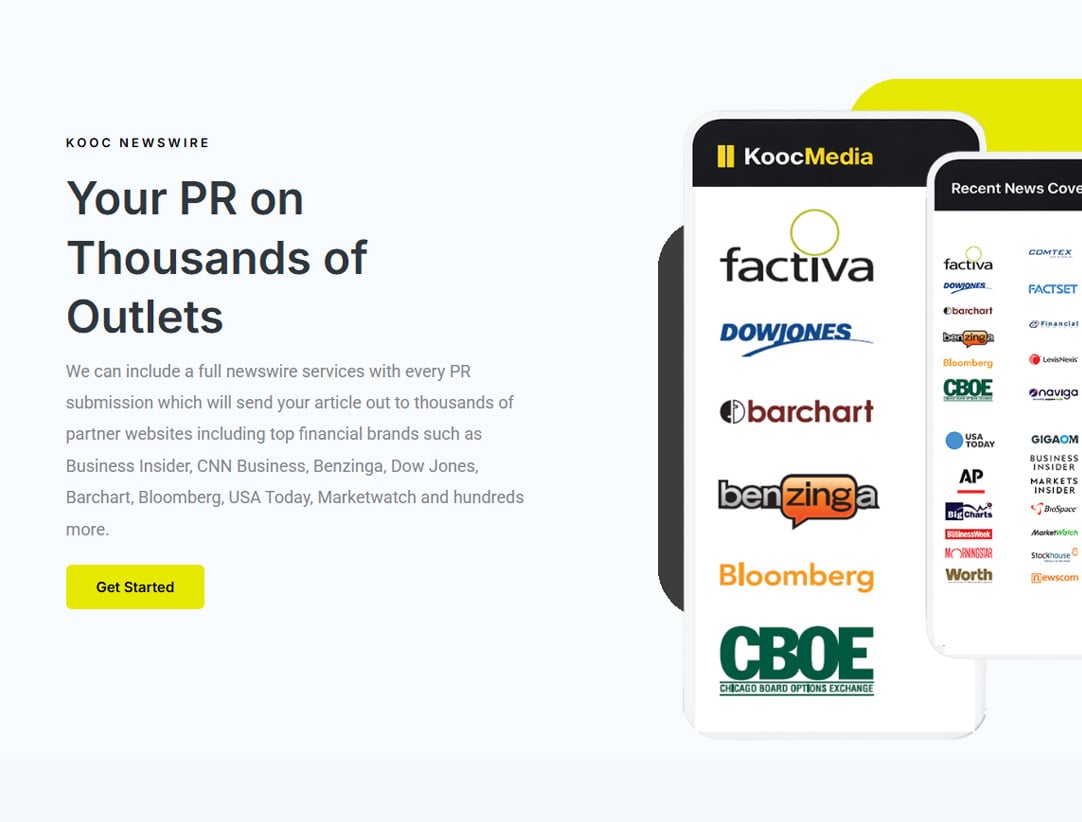
For projects that need mainstream exposure beyond crypto media, Kooc Media pushes content through major newswire networks. Depending on the package, press releases appear on outlets including Business Insider, Bloomberg, Benzinga, MarketWatch, USA Today and Dow Jones feeds. A DeFi protocol approaching institutional investors, an NFT platform courting mainstream brands or a Web3 project selling to enterprise buyers gains access to the publications those audiences read — not just the ones the crypto community reads.
Complete reporting is included. Live links to each published article. No ambiguity about what was delivered.
Campaigns Designed Around Each Sector’s Reality
The temptation in crypto PR is to treat everything under the blockchain umbrella as one category. Kooc Media resists this because DeFi, NFT and Web3 projects operate in fundamentally different markets with fundamentally different audiences.
DeFi campaigns are designed for an audience that thinks in numbers. Users evaluating a decentralised exchange want to know about trading volume, liquidity depth, chain availability, slippage tolerance and fee tiers. Users evaluating a lending protocol want to see interest rate models, collateral frameworks, liquidation mechanics, oracle dependencies and audit certifications. Users evaluating a yield strategy want performance data, risk parameters and composability details. Kooc Media’s DeFi coverage provides this information with the precision the audience demands because vague claims about “innovative DeFi solutions” are worthless to someone deciding where to deploy capital.
NFT campaigns are designed for audiences that respond to culture and experience. A digital artist evaluating a new marketplace wants to know about royalty enforcement, minting costs, discoverability features, community size and curatorial approach. A gamer evaluating an NFT platform wants to understand the gameplay, earning mechanics, asset utility and cross-game compatibility. A music fan exploring NFT collectibles wants to know what they get, how it connects them to the artist and what the community looks like. Kooc Media’s NFT coverage tells these stories in terms that connect with people who care about the experience as much as the technology.
Web3 campaigns are designed for audiences that need to see practical value before investing time in technical evaluation. A developer considering a decentralised storage solution wants to understand latency, throughput, pricing and integration complexity. An enterprise buyer evaluating a blockchain identity solution wants to know about compliance, interoperability with existing systems and real-world implementations. A startup building on a new data availability layer wants to understand what it enables that was not possible before. Kooc Media’s Web3 coverage translates infrastructure into impact.
“A DeFi lending protocol and an NFT music platform are about as similar as a bank and a record label,” said De Gouveia. “They both happen to use blockchain, but that is where the similarity ends. We treat every campaign as a distinct brief because pretending otherwise would produce coverage that serves nobody.”
Writers Who Do Not Need a Glossary
The fastest way to lose credibility with a DeFi, NFT or Web3 audience is to publish content that reveals the writer does not understand the subject matter. These communities are technically sophisticated and unforgiving. A single misused term can generate more social media discussion than the article itself — and none of it positive.
Kooc Media’s managed PR creation service avoids this entirely. Every article is produced in-house by writers who cover decentralised technology as their primary focus. They understand how concentrated liquidity works. They know why soulbound tokens matter for credential verification. They can explain recursive proof composition without reducing it to meaningless metaphors. This is not rehearsed fluency. It is the result of writing about these technologies every day for years.
Projects hand over their documentation, announcement details and target messaging. Kooc Media returns polished articles that the project’s own technical team would endorse without revision. For DeFi, NFT and Web3 teams already stretched thin across development, audits, community management and fundraising, this managed approach delivers professional media coverage with zero internal resource cost.
Search Presence That Grows While You Build
Every article on a high-authority domain creates a permanently indexed page in search results. Each page ranks for a different set of keywords relevant to the project. DeFi articles rank for decentralised exchange, DeFi lending platform, yield optimiser and liquidity protocol. NFT articles rank for NFT marketplace, digital art platform, gaming NFTs and NFT creator tools. Web3 articles rank for decentralised storage, blockchain identity, Web3 developer tools and decentralised computing.
One article creates one entry point. Monthly placements across multiple trusted publications create a growing web of entry points that expands with every campaign. Over months, the project’s search footprint spreads across Blockonomi, CoinCentral, MoneyCheck and potentially mainstream outlets like Bloomberg and Benzinga. Potential users, investors and developers searching for anything in the project’s category encounter the brand across multiple independent sources.
This compounding visibility is the most valuable long-term asset a PR strategy creates. The articles published this month drive discovery next month, next year and beyond. Each new placement strengthens the signals from the ones before it. The projects that build this presence now will still be benefiting from it long after the campaigns that created it have ended.
The projects that put it off will eventually realise they need it. But they will start from zero while their competitors are already several dozen articles deep across a network of authoritative domains. In a market where being found first usually means being chosen first, that head start is worth more than almost any other investment a DeFi, NFT or Web3 project can make.
About Kooc Media
Kooc Media was founded in 2017 as a specialist PR distribution agency for the crypto, fintech, technology and iGaming industries. The company operates its own network of in-house news websites and a large partner distribution network, delivering guaranteed media coverage across high-authority publications. Services include press release writing, sponsored articles, newswire distribution, homepage placements and full campaign reporting. Kooc Media serves clients across the crypto, fintech and gambling sectors.
Kooc Media’s Crypto PR packages are available now through the company’s website at https://kooc.co.uk.