

On July 21, eighth-ranked UFC bantamweight contender Yana Kunitskaya (13-5, 1 NC) landed in the United States ahead of her August 8 bout against fellow contender Ketlen Vieira (10-1), which was later scrapped due to the Brazilian’s withdrawal from the bout. Kunitskaya would go on to face UFC debutant and Invicta FC champion Julija Stoliarenko (9-4-1), whom she defeated by unanimous decision at UFC Fight Night: Lewis vs. Oleinik.
Within a few days of landing in the U.S. ahead of her fight, the Russian was visited by agents from the United States Anti-Doping Agency (USADA), prompting the fighter to tweet about what she claimed to be a total lack of anti-doping testing in Russia and Brazil – where Kunitskaya spent time with partner and fellow UFC athlete Thiago Santos – in the weeks prior to her stateside arrival.
@TMarretaMMA and I spent 2 months in Russia and then 6 in Brazil. @usantidoping did not test us once! My first week in the US and I’ve already been tested. Makes we wonder if all the athletes training outside of the United States are being tested regularly 🤔 @ufc @UFCRussia
— Yana Santos (@YanaKunitskaya1) July 21, 2020
Kunitskaya’s tweet illuminated a predicament central to anti-doping efforts in 2020: how does anti-doping look in the midst of a global pandemic?
The Body Lock investigated the challenges faced by anti-doping agencies, charged with testing athletes situated in countries around the globe with varying degrees of restrictions for combating the COVID-19 pandemic.
In Part One of a two-article series, The Body Lock will take a look at the impact of the COVID-19 pandemic on anti-doping, while Part Two will focus specifically on the UFC’s and anti-doping partner USADA’s testing on an international scale.
On February 3, Chinese authorities reported a total of 57 new deaths from a novel coronavirus, mostly from the city and surrounding region of Wuhan. While the world at large had not yet realized the gravity of the events that were unfolding in Asia, the International Testing Agency (ITA) announced that all anti-doping activities had been “temporarily” suspended within China’s borders.
“The situation is one of caution so as not to endanger athletes or test officials and while recognising the importance of anti-doping activities, the priorities are to maintain public health for all,” the ITA told French news outlet Agence France-Presse.
Three weeks later, the World Anti-Doping Agency (WADA) announced that testing in China would undergo a phased re-introduction, but, crucially, that it would prioritize elite level athletes from “higher-risk categories and sports,” a far cry from a full return to testing.
As the virus continued to spread to Europe, other prominent anti-doping agencies followed.

In Spain, as the country reached 5,000 deaths due to the pandemic, the Spanish Agency for Health Protection in Sport (AEPSAD) suspended all testing. AEPSAD director Jose Luis Terreros stated, “There is no sense in assigning doctors to carry out anti-doping controls when they have a social task to carry out… There are no sports competitions in Spain, and it makes no sense to go to the home of a family who is confined, three or four hours to do doping tests,” according to ABC Deportes.
In Britain, United Kingdom Anti-Doping (UKAD) announced on March 4th that “UKAD’s testing programme is carrying on as normal. Athletes can be tested anytime, anywhere.” A mere two weeks later, that decision was reviewed, and UKAD announced a “significant reduction in our testing program.”
In fact, over the months of April, May, and June 2020, UKAD would conduct just 124 tests compared with 2,017 tests over the same period of 2019. UKAD would gradually resume testing in July 2020 while observing strict social distancing protocols.
As the virus crossed seas and was recognized as a global pandemic, this pattern continued.
In the Russian Federation, all testing was suspended on March 28. Since, the Russian Anti-Doping Agency (RUSADA) is expected to have restarted its testing process on June 16.
In Australia, the national Australian Sports Anti-Doping Authority (ASADA) spoke of balancing the importance of anti-doping testing against COVID-19 concerns by implementing a “risk-based approach.”
The Anti-Doping Convention under the Council of Europe was formed in 1989 as an “international legal instrument” aimed at maintaining broad anti-doping across the continent, and the entity is made up of 52 member states: every European country, along with the Russian Federation and Australia, is represented.
Between April 27 and May 3 of 2020, the organization conducted a survey of member states regarding the impact of Covid-19 on their testing.
The graphic below indicates the responses of member states from that survey, painting a stark image of countries’ anti-doping programs’ beleaguered by the pandemic.
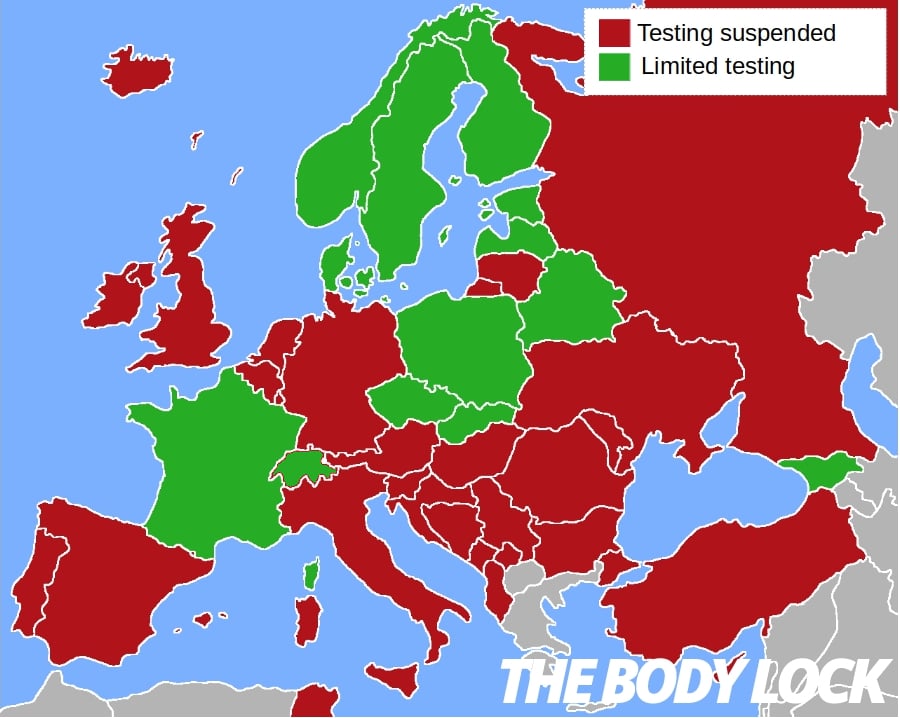
The results were dramatic.
Of the 48 countries that responded to the survey, all 48 stated that in-competition testing had for a time stopped completely, 33 respondent countries said that out-of-competition testing had been suspended completely, and only 14 countries – Australia, Belarus, Czech Republic, Denmark, Estonia, Finland, France, Georgia, Latvia, Norway, Poland, Slovakia, Sweden, Switzerland – had continued out-of-competition testing beyond March 2020, and in every instance, such testing was either massively reduced testing or mission-critical testing only.
Laboratories across the world also found themselves closing their anti-doping doors amid the challenges presented by COVID-19.
WADA confirmed in March that several labs had already suspended operations and in the ADC survey, anti-doping agencies confirmed that laboratories in four countries (France, Italy, Spain, and the United Kingdom) had suspended operations completely, and in four more (Belgium, Germany, Norway, and Romania), there had been a partial suspension.
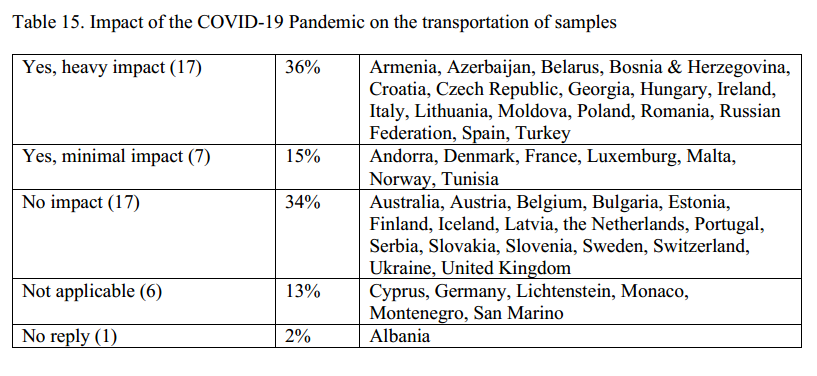
Twenty-four national agencies stated that the pandemic had impacted their ability to get samples to their laboratories.
Under the WADA Code – a governing code of anti-doping policy and procedure – blood samples are required to reach the destination laboratory within a certain timeframe and in a certain condition. With transport disrupted due to the pandemic, WADA specifically warned agencies that “shipping times and conditions to the laboratory and should be used to determine whether blood samples should be collected.”
In the United States, USADA was similarly affected, announcing in March that they would focus “only on mission-critical testing of athletes in sports still competing.”
USADA did, however, hold a couple of cards up its sleeves when considering their UFC partnership.
In 2018, USADA commenced trials on dried blood spot testing (DBS) in the UFC program. With DBS, a few drops of blood from the athlete are collected via a device pressed against the athlete’s arm.
Along with the benefits of being generally non-invasive, the dried blood spot test does not have the same transportation requirements as a traditional blood sample, meaning that even with disrupted transport links to the laboratories, blood samples could still be collected.
USADA also took the opportunity to trial remote testing, during which the athlete, essentially, conducts the sample collection by his or herself.
The sample collection equipment is delivered by courier, then the athlete is guided by a USADA doping control officer (DCO) by video call. The DCO conducts the sample provision process before a courier then collects the completed samples. Five UFC athletes (Felicia Spencer, Cory Sandhagen, Jimmie Rivera, Ashley Yoder, and Eryk Anders) took part in the trial, providing more than 70 blood and urine samples between them.
In total, between April and June 2020, USADA collected 440 samples from 309 athletes in the UFC, and while this is a dramatic reduction on the 1,000-samples-a-quarter target set by the program, it is perhaps a measure of how far the UFC program has come that this was still comparable to the first quarter of 2016 (the first full year of the program), when just 286 athletes were tested.
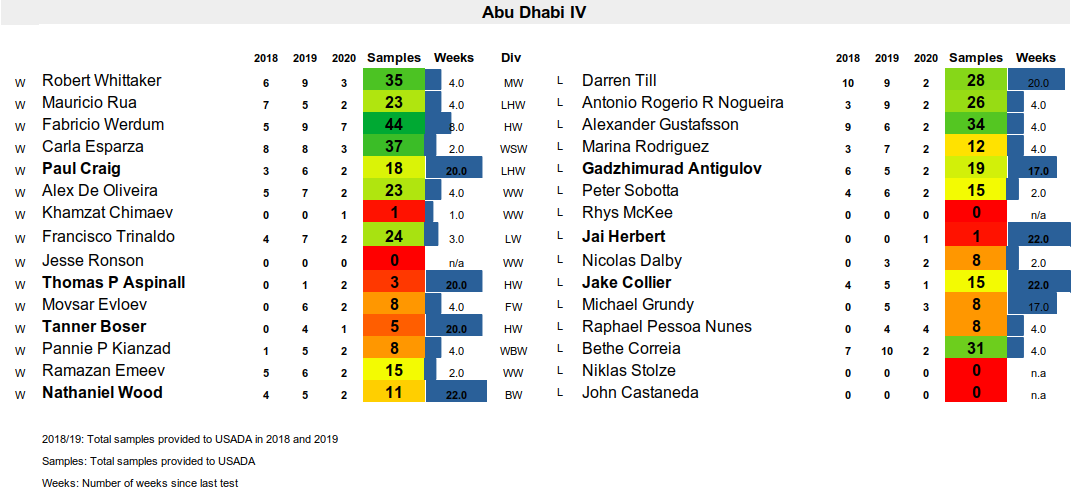
There are some signs that things are returning to normal. At the UFC’s most recent ‘Fight Island’ events – held on Yas Island in Abu Dhabi – anti-doping data showed that all but four fighters on the third event had been tested in the leadup to their bouts (excluding two new UFC debutants), the notable examples being the fighters from the United Kingdom and Ukraine where anti-doping had been suspended.
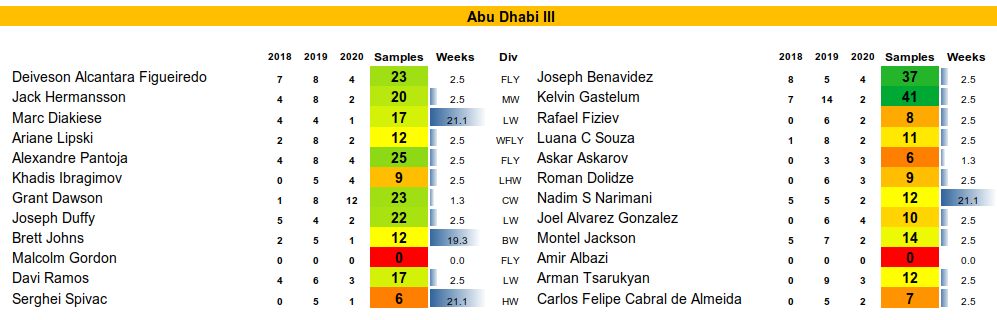
In the final event in Abu Dhabi, the story was a similar one; the bulk of the event’s fighters were tested in the weeks prior to the event, the notable exceptions being those from Europe. On both cards, it should be noted that those fighters were tested upon their arrival to ‘Fight Island.’
In Part Two of this series, The Body Lock will look specifically at how USADA conducts and manages testing for athletes in the UFC program around the world.